 ?
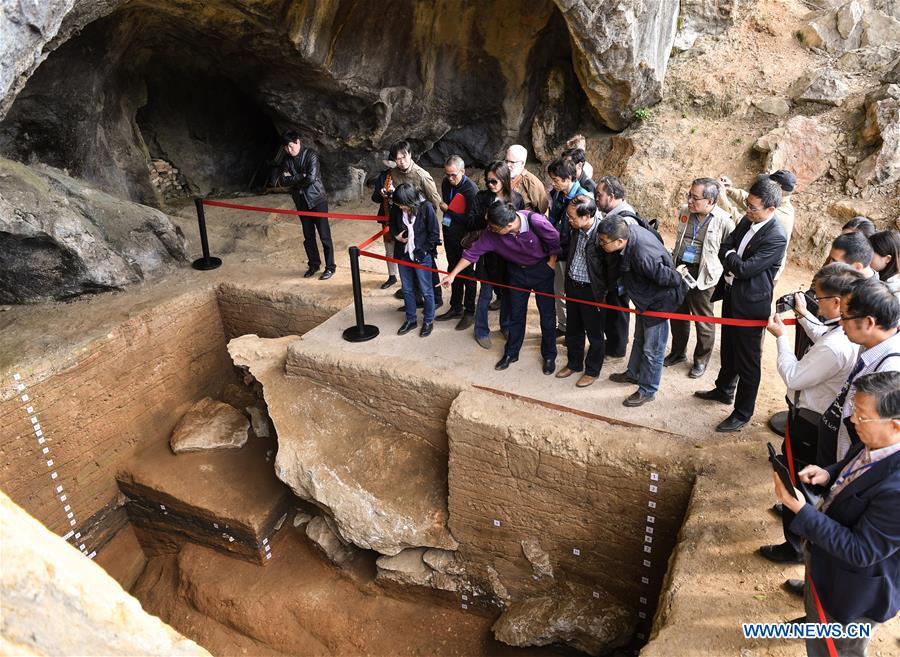
?File photo taken on Nov. 5, 2017 shows archaeologists inspecting the archaeological site in Mingxi County, southeast China's Fujian Province. Archeologists found carbonized rice and millet in a middle and late Neolithic relics dating back 5,800 to 4,300 years in today's Fujian Province. Abundant grain remains overturned the current idea that prehistoric humans relied on hunting instead of farming, and five graves found in the ruins could help discover what the people at the time did for employment. The relics also filled in archeological gaps in the northwestern part of Fujian between the middle and late Neolithic era and early dynasties including the Shang (1300 B.C.-1046 B.C.) and Zhou (1046 B.C.-771 B.C.). The findings in Fujian site was announced one of the six greatest archeological discoveries of the country in 2017 by the Chinese Academy of Social Sciences. The six findings contain information on human activity over a time span of more than 40,000 years. (Xinhua/Li He)
RICE DISCOVERED
Archeologists found carbonized rice and millet in a middle and late Neolithic relics dating back 5,800 to 4,300 years in today's east China's Fujian Province.
Abundant grain remains overturned the current idea that prehistoric humans relied on hunting instead of farming, and five graves found in the ruins could help discover what the people at the time did for employment.
The relics also filled in archeological gaps in the northwestern part of Fujian between the middle and late Neolithic era and early dynasties including the Shang (1300 B.C.-1046 B.C.) and Zhou (1046 B.C.-771 B.C.).
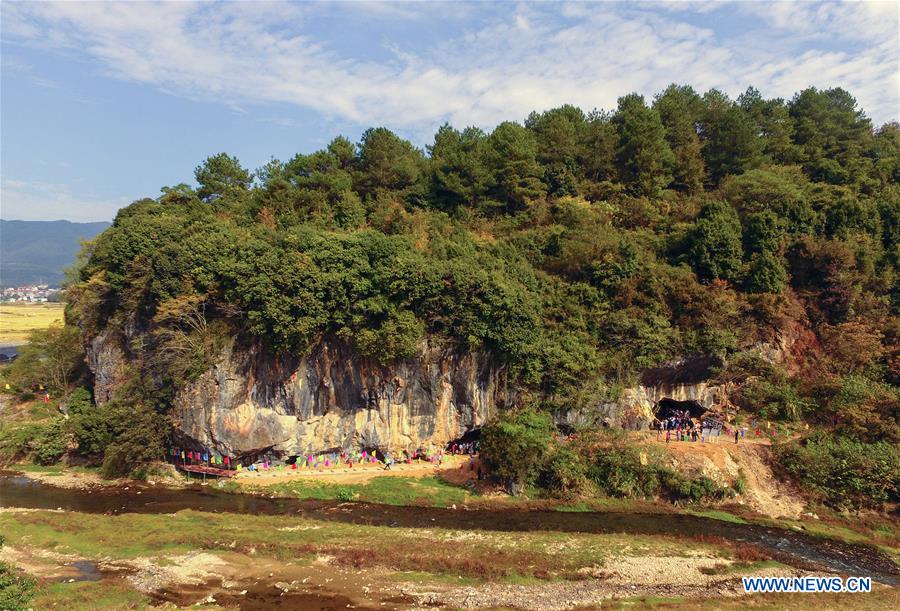
File photo taken on Nov. 5, 2017 shows the archaeological site in Mingxi County, southeast China's Fujian Province. Archeologists found carbonized rice and millet in a middle and late Neolithic relics dating back 5,800 to 4,300 years in today's Fujian Province. Abundant grain remains overturned the current idea that prehistoric humans relied on hunting instead of farming, and five graves found in the ruins could help discover what the people at the time did for employment. The relics also filled in archeological gaps in the northwestern part of Fujian between the middle and late Neolithic era and early dynasties including the Shang (1300 B.C.-1046 B.C.) and Zhou (1046 B.C.-771 B.C.). The findings in Fujian site was announced one of the six greatest archeological discoveries of the country in 2017 by the Chinese Academy of Social Sciences. The six findings contain information on human activity over a time span of more than 40,000 years. (Xinhua/Li He)